Dossier A 01 · the argument as it was made
Hockey Evidence Unveiled
Three documents did the work on the site’s lead page: a newspaper recollection, a comic sketch and a press release. They are set out here in full.
The documents
Spellings follow the originals; the smaller notes beneath each document are editorial.
- D 1 Newspaper recollection, author anonymous
Windsor Mail, 1876
The Devil’s Punch Bowl and Long Pond, back of the College, were favorite resorts, and we used to skate in winter, on moonlight nights, on the ponds. I recollect John Cunard … having his front teeth knocked out with a hurley by Pete Delancey of Annapolis.
Anonymous writer, Windsor Mail, 1876, describing his days at the school from 1816 to 1818.
The site quoted this passage without an issue or page reference. It describes skating and hurley on the pond; it does not describe hockey as a codified game.
- D 2 Periodical sketch by Thomas Chandler Haliburton
Attaché, London, 1844
… the boys let out racin’, yellin’, hollerin’, and whoopin’ like mad with pleasure, and the playground, and the game at bass in the fields, or hurley on the long pond on the ice …
Thomas Chandler Haliburton, Attaché, 1844, recalling King’s College School, which he left in 1810.
A real published text, and the oldest of the three. It is a comic sketch written thirty years after the events it recalls, and “the long pond” in it is not stated to be this pond.
- D 3 Press announcement, two pages
Nova Scotia Sport Heritage Centre release, 28 October 1988
The Nova Scotia Sport Heritage Centre in conjunction with the bicentennial celebrations of King’s-Edgehill School, Windsor, Nova Scotia, today announced new documented evidence which once again names Windsor, Nova Scotia, as the birthplace of Canadian hockey in the early 1800’s.
Announced at King’s-Edgehill School; spokesperson A. J. “Sandy” Young of Dalhousie University. The research was Leslie Loomer’s, done for the school’s bicentennial book.
The release is what the site treated as its documentary evidence; it rested on the two texts above.
The two men the page turned on
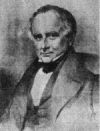
The site printed two portraits alongside its argument.
Thomas Chandler Haliburton is the author of the 1844 passage — a Nova Scotian judge and humorist, born in 1796, who left King’s College School in 1810 and later wrote the Sam Slick sketches. The claim runs from his schooldays to his sketch, across more than thirty years of recollection.
J. G. A. Creighton belongs to a different link in the chain. He is credited with taking the Halifax rules to Montreal, where a game under organised rules was played in 1875. The site put his portrait here to connect Nova Scotia to the first organised match; whether the pond at Windsor is the other end of that connection is exactly what is disputed.
The pond itself, the site noted, can still be seen on the Dill property just off the campus of what is now King’s-Edgehill School.
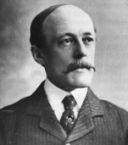
Archived caption J.G.A. Creighton (1850-1930) of Halifax, Nova Scotia is credited with introducing hockey to Montreal with Halifax rules where the first game under organized rules was played in 1875.
Adjacent files
- A 02 Site of first hockey evidence Photographs from the day of the 1988 announcement, and the visitor quotations the site collected. Archive
- A 03 Hockey re-enactment, 1999 The matches played on the ice under Halifax rules, and the pucks reported from the excavation. Archive